Overview and details
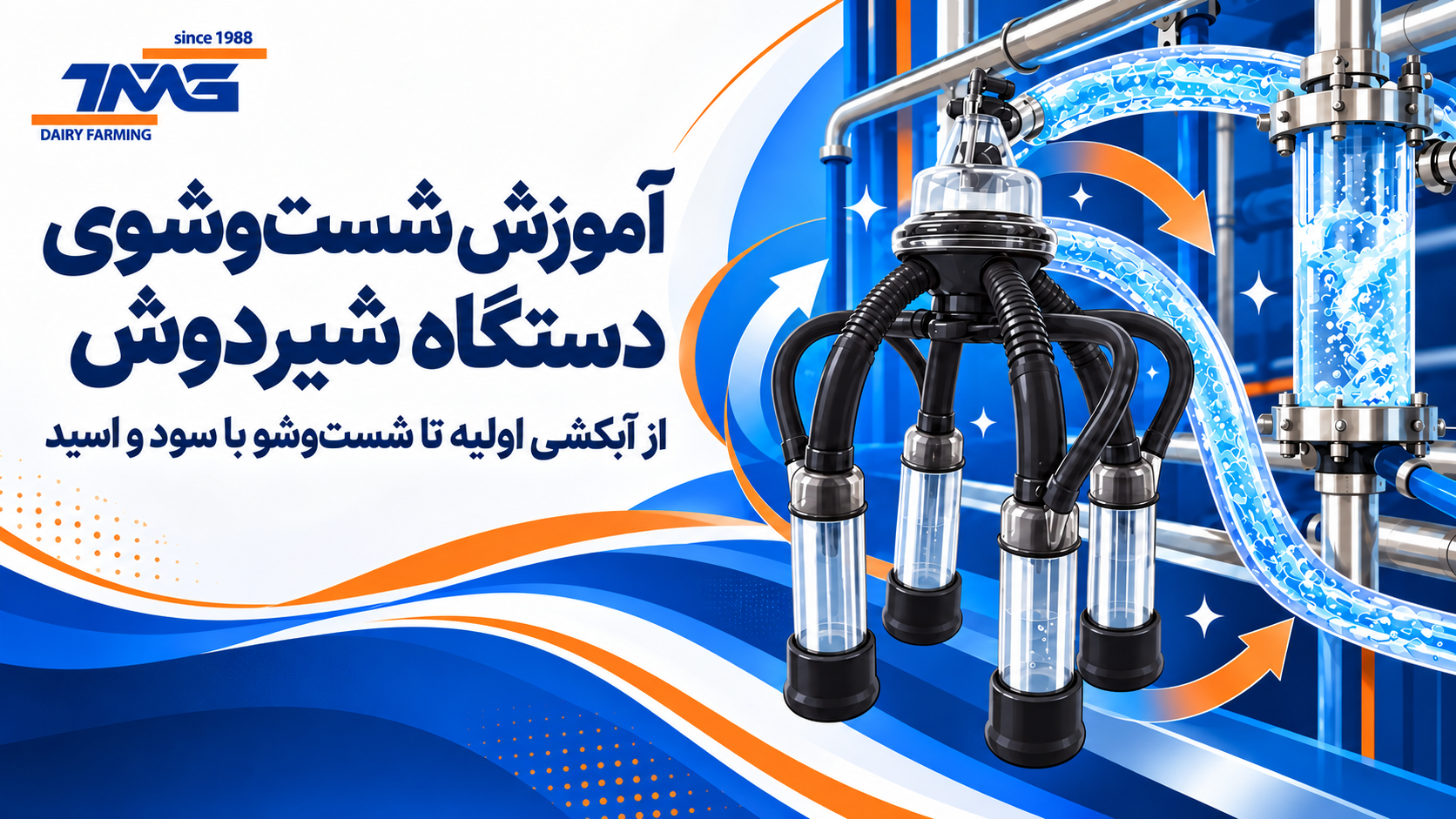
Complete Guide to Cleaning a Milking Machine
Proper cleaning of a milking machine is one of the most important tasks after every milking session. Milk residues, fat, proteins and mineral deposits can gradually build up inside liners, hoses, milk pipelines and other parts of the system if they are not removed correctly.
Cleaning is therefore not simply a matter of running water through the machine. An effective cleaning process involves several stages, including milk drainage, initial rinsing, detergent circulation and final rinsing.
Manual and Automatic Cleaning Systems
Some milking machines are cleaned manually, while others use an automated washing system.
In manual systems, the operator prepares the water and detergent and controls the washing process.
Automated systems perform much of the same process according to a preset program.
The basic cleaning principles, however, remain similar.
Drain the Remaining Milk
After milking is finished, as much residual milk as possible should be removed from the milk lines.
Depending on the machine, this may be done using the control board, a dedicated switch or another drainage system.
Reducing the amount of remaining milk makes the following rinsing and washing stages more effective.
Initial Rinse
The next step is the initial rinse.
In manually cleaned systems, a wash basin or tank is filled with water and the milking clusters are connected to the washing jets.
Vacuum draws the water through the liners, clusters, hoses and milk pipelines before it leaves the system through the outlet.
The purpose of this stage is to remove most of the remaining milk before detergent is introduced.
How Much Water Is Required?
As an initial estimate, approximately 5 to 6 litres of water may be considered for each milking unit.
For example, a four-unit machine may require roughly 20 to 24 litres, while a 12-unit machine may use around 60 litres as an initial estimate.
However, this is not a fixed rule.
Receiver capacity, pipe length and diameter, Milk Meters, recording jars and the general design of the milking system can all affect the actual volume required.
A Practical Way to Estimate Water Volume
One practical method is to observe the system as it draws water from the wash basin.
As the basin becomes nearly empty, the intake pipe may operate partly filled for several seconds while drawing a mixture of water and air.
The water that has entered the system should then return to the basin after circulating through the machine.
This behaviour can help the operator make a practical adjustment to the required water volume.
Water Temperature
Water temperature is particularly important when preparing the alkaline or acid cleaning solution.
In the practical method described here, the initial water temperature is above approximately 70°C.
This helps the cleaning chemical dissolve properly and allows the solution to enter the system at a suitable temperature.
Some temperature loss during circulation is normal.
The exact recommended temperature should always be checked against the detergent and equipment manufacturer's instructions.
Detergent Circulation Time
Once the cleaning solution has been prepared, it needs enough time to circulate through the milking system.
Depending on the system, the circulation period may be around 20 to 30 minutes.
During this period, the cleaning solution repeatedly travels through the liners, hoses, pipelines and other milk-contact surfaces.
This gives the detergent enough contact time to loosen and remove contamination.
Role of Alkaline Cleaner
An alkaline cleaner is mainly used for removing organic contamination.
Milk fat, proteins and other milk residues are among the materials that alkaline detergents help remove from internal surfaces.
Its main role can therefore be described as degreasing and removing organic milk residues.
Why Acid Cleaning Is Also Important
Using only an alkaline cleaner may leave certain mineral deposits inside the system.
An acid cleaner has a different role and is mainly used to help control mineral deposits.
For this reason, alkaline and acid cleaners should be viewed as complementary rather than interchangeable.
Alkaline cleaning mainly targets organic residues, while acid cleaning targets mineral deposits.
Detergent Concentration
Concentrations of approximately 1 to 1.5 percent, and in some cases up to about 2 percent, are mentioned in the practical method described here.
However, these figures should not be treated as universal instructions.
Different detergents have different formulations, so the correct concentration should always be based on the detergent manufacturer's label and the milking equipment manufacturer's recommendations.
Example for a 12-Unit Machine
If a 12-unit milking machine requires approximately 60 litres of water, this volume is first prepared in the washing tank.
The required amount of detergent is then calculated according to the recommended concentration for that specific product.
The correct approach is therefore to determine the actual water volume first and then calculate the detergent quantity.
Alkaline and Acid Cleaning Schedule
In automated systems, alkaline and acid washing can be arranged according to a regular program.
For example, one practical schedule may use alkaline detergent in one cleaning cycle, acid cleaner in the next and alkaline detergent again in the following cycle.
In a farm milking three times per day, this can result in two alkaline cycles and one acid cycle as a practical example.
This is not a universal rule and should be adjusted according to water quality, equipment design and manufacturer recommendations.
Cleaning Non-Automated Systems
A similar approach can be used for simpler systems.
If milking is carried out three times per day, there are 21 milking sessions in one week.
In the practical approach described here, two or three of those cleaning cycles may be performed with an acid cleaner while alkaline cleaner is used for most of the remaining cycles.
The actual frequency may vary, especially where water hardness and mineral deposits are high.
Final Rinse
After the cleaning solution has circulated for the required period, it is drained from the system.
The wash basin is then filled again with clean water and the system is rinsed.
The goal of the final rinse is to remove remaining cleaning chemicals from liners, hoses, pipelines, the receiver, Milk Meters and other milk-contact parts.
Conclusion
Effective milking machine cleaning depends on several factors working together.
The system should first be drained of residual milk and rinsed. The correct amount of water is then prepared, detergent is added at the appropriate concentration and the solution is circulated for sufficient time.
Alkaline cleaners mainly remove milk fat and organic residues, while acid cleaners help control mineral deposits.
A final rinse completes the process.
Because milking systems vary considerably, water volume, temperature, detergent concentration and cleaning frequency should always be adjusted according to the equipment and chemical manufacturer's instructions.
Comments 0
No approved comments yet. Start the discussion.
Leave a comment
Your comment will be published after moderation.